Wednesday, October 13, 2010

People Play Games #3: Monopoly/Battleship

People Play Games is back, taking another look at old video games that are uniquely terrible for one reason or another. Today, we’ll discuss video games based on board games, looking at the examples of Monopoly and Battleship, both for the Nintendo Entertainment System.


It’s hard not to like a good board game. They’re inexpensive, they’re easy to learn, and they provide simple but competitive fun. Additionally, most of the classic ones have been around for like a hundred years, so board games like Monopoly and Battleship are ingrained in American culture. Even if you’ve never played a game of Monopoly, you probably know how it works and what it’s about.


For some reason, video game companies thought that consumers would want to spend $50 to play these age-old American institutions in a newer, shittier way. Never mind the fact that a copy of the real Monopoly is probably in the area of $20, that a board game is inherently more interactive and fun because you are actually rolling the dice and moving the pieces, and that no one has any need or desire for a digital Monopoly game.


This miscalculation could be forgiven if the video game sported amazing graphics or put a new, fun slant on the original game. Of course, it doesn’t. Unless I see the thimble and the iron popping out of my television set or unless I’m getting real money to play it, I think I’d rather play the real game with real people.


But does it feel like the real Monopoly? When playing board games, there is inherent and constant shit-talking, especially when some poor sap just landed on your deluxe hotel property and now has to fork over all of their cash. In the NES Monopoly, the game moves so fast you hardly have any idea what the fuck is going on. The computer rolls the dice, lands on a property and purchases it in the space of four seconds.


Yeah, that looks just as good as playing the real thing, right? So Monopoly for Nintendo offers no discernable reason for playing it over the real board game and it costs $30 more. Why was this made?


If Monopoly is the baseball of board games (a patient and strategic game, takes forever to play, has been around forever), Battleship is the football. The action is violent and quick, players slowly squeeze the life out of each other once they get a “hit”, and the game can turn around in an instant if your opponent gives you an opening. Again, this sounds more exciting in real life, right?


Battleship for NES adds some insane “wrinkles” to the classic game, allowing the player to use “depth charges” and shoot five missiles at once. I point to this as evidence that the game didn’t need to be made in the first place. Everyone loves Battleship. I don’t think you can find a person who knows what Battleship is that doesn’t adore it. People like it the way it is. The only justification for its existence on Nintendo is that the programmers piled some stupid shit on top of it and claimed it was a new game.


In past articles on the Musicarium, we’ve discussed media that claimed to promote family values while simultaneously undermining them. The Tamagotchi allowed kids to raise a virtual pet when a real life pet is much more fun and rewarding. TGIF told families to sit and watch other, better families on TV and passed this off as a family activity. Board games can be played by anyone, but I’d wager the first thing you think of when you think of the term “board game” is a family sitting around a table playing one. In this instance, board games are perfect the way they are. The idea of improving on them by making a group of people perform yet another activity where they sit around a television is a tad insidious.


Although, it is cool to see the enemy battleship actually blow up.


John Lacey

Monday, October 11, 2010

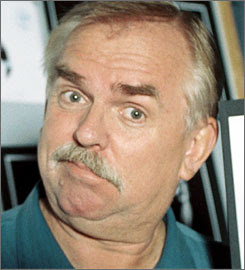
People We Hate #1

This is pretty self-explanatory. We post a picture of someone we dislike or find annoying. You comment on it. Caption the photo, say whether you agree or disagree with the hatred, etc.


John Ratzenberger

Tuesday, October 5, 2010

Ryan Bingham & The Dead Horses - Junky Star


Ryan Bingham & The Dead Horses
Junky Star
2010 Lost Highway

Junky Star is the latest release from Ryan Bingham, the Americana-country-folk-rock fusion artist known primarily for his amazing guitar work and raspy “beyond his years” vocals. Junky Star is the third official album from Bingham and his Dead Horses backing band, following 2007’s Mescalito and 2009’s Roadhouse Sun. Bingham also contributed to the soundtrack for the 2009 film Crazy Heart, penning the Academy Award-winning track “The Weary Kind” for that movie.

His previous efforts are strong throughout and provide many reasons to be excited about his emergence. They don’t quite put it all together at once, but there were enough inspired moments to believe that Bingham was capable of creating a masterpiece, and it was hoped that Junky Star would hit the home run that fans had been waiting for.

In order to create such a cohesive, strong album, Bingham is forced to walk a tightrope between his two styles. He has one hand in traditional acoustic country-folk and the other in stampeding hard rock, and these styles often manifest themselves from song to song or sometimes within one track. The first two songs, “The Poet” and “The Wandering”, are both harmonica driven tunes displaying this dichotomy between the two styles of Bingham’s music. “The Poet” is direct and controlled, while “The Wandering” is fast and loose.

Bingham has the ability to go dark, as evidenced by the twangy, desperate and paranoid “Strange Feelin’ In The Air”, perhaps the album’s best song. This track contains a fine example of Bingham’s oft-employed breakdowns, where the song deviates from verse-chorus conventions and explodes into a multi-layered groove. Some of Bingham’s material, like the title track of the record, can be sparse, but it often works in reflection of what he’s singing about, especially on his Springsteen-esque stories of the dusty downtrodden.

Junky Star covers a variety of styles without problem. The record moves from contemplative acoustic folk to riff-heavy Americana to road house bar blues and back again, and neither the music nor the album’s structure suffer for it. The record strikes a much better balance between his tones than his previous work and keeps things on an even keel, eschewing the jarring transitions between tracks that disrupted his other albums and allowing things to fit together more seamlessly.

Bingham is only twenty-nine, but we get a sense that he is the real deal, and it’s not just because of his rootsy music. His gruff voice and stories of the dust covered back roads of the country ring authentic. He’s a trustworthy guide, knowledgeable of the material he’s singing about despite his young age. There’s a Bob Dylan quality about Ryan Bingham; someone who tells human stories with authority and who is talented enough to back up those stories with his music.

I’m not certain that this is the breakthrough that Bingham was hoping for, however: there really isn’t one knockout song in particularly that carries the rest of the record on its back. But there are a number of good songs not discussed above (the eerie “Hallelujah”, the sorrowful “Self-Righteous Wall”, and the raucous “Direction of the Wind”, to name three), and Junky Star represents a collection of music featuring a number of improvements over his previous two albums. Better lyrics, better structure, and evidence of an improved songwriter jump to mind. Maybe he’ll hit the grand slam next time around.

B+

John Lacey

Wednesday, September 29, 2010

The Dailies 9/29/10 - I've Fallen Way Behind

Well, I’ve watched a lot of movies recently, many of them really fucking good. So let’s dive right in.

Trailers

Stray Dog (1949) – C
- Directed by Akira Kurosawa
- Starring Toshiro Mifune, Takashi Shimura, Keiko Awaji
- Yes, it’s a Kurosawa picture, but the incredibly slow pace and the hopeless reactions of the characters to nearly every obstacle they encounter led to the average grade.

It’s a Mad, Mad, Mad, Mad World (1963) – B-
- Directed by Stanley Kramer
- Starring Spencer Tracy, Milton Berle, Sid Caesar, Jonathan Winters and countless others
- Awards: Won – Best Sound Effects. Nominated – Best Color Cinematography, Best Film Editing, Best Original Song, Best Original Score, Best Sound
- An endlessly spoofed treasure hunt comedy featuring pretty much every funny screen personality from the turn of the century to its release.

The Wages of Fear (1953) – A-
- Directed by Henri-Georges Clouzot
- Starring Yves Montand, Charles Vanel, Peter van Eyck, Folco Lulli
- An effortlessly and incredibly tense story of four downtrodden men tapped to drive unstable dynamite across treacherous terrain.

The Hustler (1961) – A-
- Directed by Robert Rossen
- Starring Paul Newman, Jackie Gleason, Piper Laurie, George S. Scott
- Awards: Won – Best Black & White Set Decoration, Best Black & White Cinematography. Nominated – Best Actor (Newman), Best Supporting Actor (Gleason), Best Supporting Actor (Scott), Best Actress (Laurie), Best Director, Best Adapted Screenplay, Best Picture
- A movie about a pool hustler that becomes much more than that due to four epic performances by the principals.

Stroszek (1977) – A
- Directed by Werner Herzog
- Starring Bruno S., Eva Mattes, Clemens Scheitz
- A Herzog classic that doesn’t star Klaus Kinski, and already one of my favorite films ever.

Rocky Balboa (2006) – B+
- Directed by Sylvester Stallone
- Starring Sylvester Stallone, Antonio Tarver, Milo Ventimiglia, Burt Young
- Much, much better than a sixth Rocky movie has any right to be.

Maxed Out: Hard Times, Easy Credit and the Era of Predatory Lenders (2006) – C-
- Directed by James D. Scurlock
- Featuring various talking heads
- A documentary that purports to inform us of predatory credit card practices and ends up telling us nothing we didn’t already know.

Features


The American (2010)
Directed by Anton Corbijn
Starring George Clooney, Violante Placido, Irina Bjorklund

Here’s a film that’s too patient, too deliberate and perhaps too directionless for its own good. The material in The American screams for more action; for the film to shed its meticulousness and give us some sort of blow-off that never arrives. I’m a believer that one can make a good film about anything, and there is a good film to be made with this story. Unfortunately, that film will have to be made another time.

George Clooney plays an experienced assassin who takes into hiding in Italy shortly after the film begins. You see, the film opens with Clooney being nearly killed by assassins in Sweden, which causes him to go on the run. We are not told who the Swedes are or why they want to kill Clooney, but this actually becomes inconsequential as we continue. The American admittedly does a fine job of keeping Clooney’s encounters in Italy self-contained, so that we don’t need to know who is pursuing him to get the gist of what’s happening.

Though the film begins promisingly, it eventually feels like we just start following Clooney’s character around as he does different things. It doesn’t feel like a cohesive film. Things happen, and the camera films them, but it all feels empty and rather pointless. The American is so purposely esoteric that it eliminates most of the investment we have in its characters.

The American does have its merits. It looks fantastic. It is shot very sharply and very well. The Italian scenery is great to look at. It features a couple of incredibly beautiful women. Clooney does a nice job as the tired, lonely veteran assassin, who just wants to leave the killing business and settle down on a villa somewhere but realizes that’s probably not realistic for his line of work (which is itself a tired theme). The other actors and actresses perform admirably as well. It’s too bad there’s just not enough going on to care.

C-


The Town (2010)
Directed by Ben Affleck
Starring Ben Affleck, Rebecca Hall, Jon Hamm, Jeremy Renner

The Town is half blue-collar crime film and half romance film, with elements from each intersecting with each other in different ways. It’s a slick film with well-done action sequences, but its great flaw is its attempt to try to be more than it really is.

The Town concerns a group of bank robbers from the Charlestown neighborhood of Boston, who are led by Ben Affleck. We start with a bank robbery in Harvard Square, where things go awry and the group takes a hostage (Hall). After the robbery, the gang finds that the hostage lives in Charlestown and Affleck sets off to intimidate her, but ends up falling for her instead. He then has to keep his bank robbing activity secret from her while continuing his illegal activities.

The film serves as a commercial for Boston, with great chase scenes taking place in the claustrophobic North End section and a final shootout occurring at Fenway Park. These and other action scenes in The Town provide the most enjoyable aspect of the film; back to basics police vs. bad guys car chases and gunfighting.

Storyline problems, however, haunt the film. Believability issues are a constant, glaring annoyance. Rebecca Hall’s character repeats that the hostage encounter was the worst experience of her life, but when she finds out that Affleck was one of the robbers (he was disguised during the heist), her fury dissipates almost immediately and she remains in love with him. The police, despite knowing that Affleck and his gang are responsible for the rash of bank robberies in the area but not having enough evidence to convict, somehow forget to tail them at the end of the film, allowing them to participate in the Fenway Park theft.

The acting helps us move beyond these problems. Affleck has played “young blue collar Boston bozo” more times than I care to remember, but he does it reliably well. His best friend and second-in-command Jeremy Renner is terrific as the psychotic muscle of the group. Jon Hamm, so great as Don Draper on Mad Men, is unfortunately saddled with a one-dimensional and thankless role as stock “threatening FBI agent”.

The Town should have stuck to its guns as an action-thriller. The love between Affleck and Hall is forced and unbelievable and barely affects the outcome of the film. The addition of cornball romance to the central story was used as a device to make the film seem like more than it really is when it would have been fine all along.

B-

John Lacey

Wednesday, September 1, 2010

Film Convention #2: Badass Western Artifacts and Weaponry

Two vital components to any western film are aura and legend. Successful westerns need to convey an inherent primordial lawlessness and chaos that would allow the characters in them to exist and thrive. Everything contributes to this feeling: the horses, the guns, the outpost town and its saloons and hotels, the desert or mountain surroundings, even the dirt and grime that covers most of the people. All of these factors must be spot-on in order to create the western illusion and to allow us to suspend our disbelief.

Nothing in a western embodies aura and legend more than the heroes and villains in these films. Their exploits are often well known by the other characters in the town, who speak of them in reverent or frightful tones. Western heroes and villains often have either cool or menacing nicknames, immediately distinguishing them from the two-dimensional riff-raff that otherwise inhabits the town. These characters command authority, from the other characters, from the filmmakers, and ultimately, from the viewer.
A convention often used in western films to push these main characters over the top is to adorn them with an artifact or weapon that works to strengthen the character’s motives or to make them seem even more unstoppable. Today, we’ll take a look at a few examples. Some are items, but not weapons, that spell doom for an enemy when they make their appearance. Others are unique or formidable weapons, like guns or knives, that give them an advantage in their nomadic travels and chance encounters.


“El Indio” – played by Gian Maria Volonté – For A Few Dollars More (1965)

“El Indio” is the principal villain in the second film of the Man with No Name trilogy (following A Fistful of Dollars and preceding The Good, the Bad, And the Ugly). Indio is the most wanted fugitive of the outlaw west. He’s a seemingly bipolar killer who operates under the pretense of being a bandit and bank robber. Though much of the action in the film revolves around an Indio-orchestrated bank robbery, the man himself is insanely detached from his actions, and we only see glimpses of his genuine humanity when he tortures and kills his enemies and those unfortunate enough to run afoul of him.

To torture, he uses a musical pocketwatch. He obtained the pocketwatch, we learn, from a woman he raped years ago. The woman was so disgusted and shamed that she committed suicide in the middle of the crime, and Indio stole her pocketwatch as a keepsake of that demented moment. Indio challenges his opponents to duels in the film, using the chimes of the pocketwatch as an indicator of when the duel begins and when the participants can fire on one another. Only Indio knows the chimes of the watch and exactly when the music will end. Multiple scenes in For A Few Dollars More consist of Indio’s enemy rigid with fright, awaiting an inevitable death while they both wait for the chimes to complete. Indio couples this unfair advantage with his expert gunmanship, meaning that the chimes of the pocketwatch mean certain death for whoever hears them.

“Silence” – played by Jean-Louis Trintignant – The Great Silence (1968)

Sometimes these weapons and artifacts don’t have a long back story. Silence, the appropriately named hero of The Great Silence, eliminates evil bounty hunters with a simple but awesome rapid-fire pistol. No story is given as to its origin, but we can tell from the way that Silence shoots this pistol that he’s had it for a long time, and that it has ended the lives of many people. Whereas in some films, like the aforementioned For A Few Dollars More, the item adds to and builds on the character, in some cases the character adds to the item. The protagonists in The Great Silence are Silence, a mute, scarred gunfighter railing against frontier injustice, and the maniacal Loco (played by Klaus Kinski), a bounty-hunting killer indiscriminately and excessively ravaging the local populace. Their conflicting personalities drive the film, and in this case they lend weight and importance to their weapons, particularly whether Silence has enough firepower to overcome his nemesis.

“Harmonica” – played by Charles Bronson – Once Upon a Time in the West (1968)

The harmonica in Once Upon a Time in the West serves a similar purpose to the pocketwatch in For A Few Dollars More (which makes sense, because Sergio Leone directed both films). The harmonica is meant to portend doom for those who hear it. Charles Bronson (he of Death Wish fame) plays “Harmonica”, who is actually unnamed in the film but gains this moniker because of his penchant for playing an eerie repeating tune on his namesake throughout the film.

Harmonica spends the film following Frank (Henry Fonda, in perhaps the best villainous performance in film history). You see, years before the events of the film, Frank tied a noose around Harmonica’s older brother’s neck, and forced Harmonica to support his brother and save him from hanging by standing underneath him for support. As Harmonica struggled, Frank stuffed an actual harmonica in his mouth, hence the gimmick and the name. The older brother died, but the harmonica became a calling card and provided a swan song to those that would soon be defeated in battle. Frank, too, is forced to hear that eerie song right before Harmonica gets his revenge.

“Django” – played by Franco Nero – Django (1966)

Django may have the greatest weapon of all western characters. A hero, he drags a coffin with him everywhere he goes. We don’t at first know what is in the coffin, but when Django is pressed into combat, we learn that it conceals a machine gun, which makes quick work of his pistol-carrying adversaries.

The Django character is an interesting case because the machine gun itself is so ridiculous and dwarfs the relatively puny weaponry of his foes, allowing Django to destroy large quantities of enemies at once. More interesting is the visual aesthetic of Django dragging his coffin, an image that has been recycled by a number of musicians and films (including countless copycat Django-themed westerns). The coffin gun provides both the character and the film an iconic weapon and an indelible image.


“Britt” – played by James Coburn – The Magnificent Seven (1960)

You may know James Coburn as the old commodore who didn’t cheat well enough at the final poker table in Maverick, but thirty-five years prior he was a switchblade-throwing hero in The Magnificent Seven. Coburn later became a western veteran, but here he was a fresh-faced newcomer to the genre, playing a character that is lightning-quick with a knife.

Knives aren’t often used as primary weapons in westerns because they aren’t as exciting as guns, but the film takes pains to show just how good Coburn is to establish him as a threat. When we’re introduced to him, we see him challenged to throw his knife faster than a bullet. He easily wins the contest, but the challenger demands that they duel, knife against bullet, for real. Coburn wins that battle, too, showing that western weaponry isn’t limited to enormous or otherwise crazy guns.

John Lacey

Monday, August 23, 2010

Sun Kil Moon - Admiral Fell Promises


Sun Kil Moon
Admiral Fell Promises
2010 Caldo Verde

Mark Kozelek, the driving force (and perhaps the only force) behind Sun Kil Moon, began his music career in earnest as a member of the band Red House Painters. That band released several albums over the course of a decade or so until they split in 2001, and since then, Kozelek has been releasing a string of albums under both his own name and the Sun Kil Moon moniker. Admiral Fell Promises is the fourth album to bear the Sun Kil Moon name, following the fantastic Ghosts of the Great Highway (2003), Tiny Cities (2005) and April (2008) albums.

Kozelek’s lyrics are perhaps the main attraction to his music. He’s a very literal wordsmith. His music is soaked in nostalgia; most Kozelek songs, Sun Kil Moon or otherwise, concern remembrances of particular people and places. Kozelek is brilliant at bringing the listener to these places and painting an image with his words. The music acts as a solvent for those words, allowing us to glide through Kozelek’s thoughts and feelings seamlessly.

Though most of Kozelek’s output follows the same trajectory, most of his albums will erupt in a cascade of sound at just the right moments to provide some relief from the occasionally heavy melancholic nostalgia. Admiral Fell Promises is much more straightforward than Sun Kil Moon’s previous albums, opting for perennial sparseness and lightness and eschewing the more rocking elements of the previous records. Beautiful guitar work and strong lyrics abound, but Admiral Fell Promises doesn’t pack the punch of Sun Kil Moon’s earlier work and can’t match the otherworldly heights of those albums.

We start with “Ålesund”, a very pretty song with a simple acoustic guitar complimenting Kozelek’s haunted voice. All songs on Admiral Fell Promises consist of Kozelek and his acoustic guitar, which makes this sound more like an exercise in classical guitar than a rock record. Any type of percussion is rare and the music is rarely punched up, relying on Kozelek’s powerful vocals and force of will to push songs over the top.

The album continues with a number of nice, thoughtful songs, all providing enjoyable listens but never deviating from the mean or powering their way out of the speakers. The album’s fourth track, “Third And Seneca”, is the first to command attention, starting light but eventually picking up and changing tempo and sound, providing the album with a needed shift. Kozelek sings about the view from his apartment window and thinks about the places he’s been in illuminating simplicity:

Seattle black, Alaska blue
Oregon gray, raincloud Vancouver
Dead in Denver, drowsy Idaho
Just dreams away from your love, San Francisco

Sometimes songs go the other way, which also works well. “The Leaning Tree” starts softly, but morphs into a somber acoustic soundscape without resorting to a jarring transition. Songs continue to flow nicely into one another, each beautiful but largely lacking impression. Admiral Fell Promises is almost boringly beautiful, because Kozelek makes every song sound so nice and it seems so easy for him to write them. One nice thing about Kozelek is this effortlessness. Kozelek and Sun Kil Moon might be revelatory for people who like to slow down, take their time, and look around every now and then. Kozelek isn’t in a rush, and he’s one of the few songwriters with the innate ability to transfer this spirit into his music and have it make sense.

Despite the collection of good songs and the cohesion between them, Admiral Fell Promises can’t help but feel like a slight disappointment based on Sun Kil Moon’s previous, absolutely brilliant output. Where the three previous Sun Kil Moon records were dynamic and different, Admiral Fell Promises doesn’t take any chances and doesn’t stray far from its melancholy classical acoustic core. The lyrics remain top notch, but the album lacks the strength to make them as vibrant as they should be. This album is certainly a worthy endeavor, but one that might cause some lapses in concentration while listening to it.

B.

John Lacey

Friday, August 13, 2010

The Random Ten #19


#1) Wilco – “I Must Be High” – A.M. (1995)

“I Must Be High” is the first song from Wilco’s first album, A.M. On A.M., Wilco had not yet progressed into the atmospheric, droning rock they would later become famous for. There would be elements of those strange places Wilco would boldly go on their second album, Being There (1996), and their experimental pop-rock would become fully fledged with the Summerteeth album (1999).

There’s nothing on “I Must Be High” or A.M. in general that indicates that Wilco would head in that direction. It’s mostly straightforward country-influenced pop rock, not differing a great deal from what lead singer and guitarist Jeff Tweedy and his other Wilco band mates at the time had been doing with previous band Uncle Tupelo. Much of A.M. could be considered bland in light of Wilco’s later work, but there’s a lot to like, including “I Must Be High”. It’s a solid pop song, and is perhaps the strongest track from an album that showcases a new band trying to find its footing and starting off by playing what they know.

#2) The Jayhawks – “Ain’t No End” – Blue Earth (1989)

We’ve covered the Jayhawks here a few times before, and each time I hear them I always enjoy the experience but then never follow up by continuing to listen to their material. Whereas a lot of their songs can be called bluegrass-infused alt-country, “Ain’t No End” is more reminiscent of Neil Young in terms of guitar work. It’s a more grungy sound; not as clean as a lot of what I’ve heard from them previously. Usually, dirty alt-country is solid, but “Ain’t No End” doesn’t have any surprises or rewards within it. It’s just a nice boozy rock song, which is perfectly acceptable.

#3) Ryan Adams – “Come Pick Me Up” – Heartbreaker (2000)

I don’t think Ryan Adams has the capacity to write an unpleasant song. Pretty much every song I’ve ever heard from the guy is competent and enjoyable, even though he’s often writing about horrific break-ups or unrequited love or various other maudlin topics.

Adams has a way of writing about love and relationships in a way that sounds corny on the surface, but works because of the music surrounding those words. On “Come Pick Me Up”, he pleads for the object of his affection to “steal his records”, because even that type of relationship with this girl would be better than none at all. What sounds lame actually comes across sounding poignant, helped in no small part by a great harmonica section that pushes the song over the top.

#4) Pink Floyd – “Stop” – The Wall (1979)

“Stop” is a 29 second interstitial piano piece on side four of Pink Floyd’s opus The Wall, sandwiched between “Waiting For The Worms” and “The Trial”. It’s meant to push the story of the album forward, and really isn’t much of a song on its own. It’s too brief to be noteworthy.

#5) Beck – “Ramshackle” – Odelay (1996)

You can’t say Odelay was Beck’s breakthrough album, because he’s been on the charts pretty much since day one with “Loser” from the Mellow Gold album (1994). Odelay was the album, however, that proved Beck was not a fluke, spawning several hit singles and selling millions of copies.

“Ramshackle” is a light guitar driven song that is a noticeable departure from some of the busy, electronic singles that made Odelay such a success. “Ramshackle” is a definite harbinger that Beck would change his style significantly in the near future, shifting over to minimalistic guitar-based pop on Mutations (1998) and the brilliant Sea Change (2002). What remains interesting about Beck is that his sound is so unmistakable, whether the song is raucous and rambunctious or slow and introspective. He shines through his material, no matter what type of music he’s playing, which is a strong credit to him. He also usually writes really good songs.

#6) Sebadoh – “Sickles And Hammers” – III (1991)

Sebadoh are purveyors of fast paced garage-indie, and their catalog largely consists of songs that last no longer than a minute. Sometimes this is a blessing, because some of these songs consist of nothing more than abrasive noise that could hardly be considered songs at all. Other times, however, Sebadoh strikes a pleasurable chord, and the short length of their songs is more of a frustration. “Sickles And Hammers”, from the band’s much lauded third album III, is fifty seconds of blazing electric guitar and drumming. Like most of their output, it’s very raw, but that sound is a great match for this kind of material. If only it were longer.

#7) Beastie Boys – “Namasté” – Check Your Head (1992)

Some people love the Beastie Boys and consider them to be their favorite band. They’ve always been more of a curiosity to me than a necessity. I was first introduced to them through my older sister, and I heard their string of big radio hits, but I’ve wondered for a while what it is about their music that speaks to so many people.

“Namasté” is not a “stereotypical” fun/raunchy Beastie Boys song. It’s more of a jazz-funk fusion beat, with spoken narration in lieu of rapping. It incorporates psychedelic elements (echoes and other effects), and though it was unexpected, “Namasté” is quite a pleasant listen.

#8) Zero 7 – “Futures” – The Garden (2006)

Zero 7’s The Garden album includes all sorts of different styles, with some sprawling electronic epics and some songs that tone down the machine-made effects and take a more traditional approach. “Futures” has an excellent melody, with simple acoustic guitar, a great bassline, and sprinkles of electronic elements. The vocal harmonies conjure images of Crosby, Stills, and Nash, which end up fitting the music well even though they sound out of place. This is interesting and quite good.

#9) Radiohead – “Prove Yourself” – Pablo Honey (1993)

“Prove Yourself” is a song from Radiohead’s debut album, which gained them worldwide exposure, but not quite the cartoonish super-exposure that would follow with their subsequent albums. Though I really enjoy Radiohead’s atmospheric and electronic work on their more famous records, they were once a really good pop rock act, as “Prove Yourself” shows.

The song is charmingly 90’s sounding, going through the standard verse-chorus-verse-solo convention, but it is really catchy and good. For Radiohead fans that are unfamiliar with their early work, this is well worth checking out.

#10) Red Hot Chili Peppers – “Naked In The Rain” – Blood Sugar Sex Magik (1991)

I remain of the opinion that Blood Sugar Sex Magik is one of the best albums of the 90s. It contained singles that could be played on both rock and top 40 radio, and a number of unheralded songs that glued the whole thing together. “Naked In The Rain” has the classic Chili Peppers sound, with Anthony Kiedis singing like a wild man and Flea moving the song along with one of his trademark funk basslines, all linked together by a simple and strong chorus. It shows how good the album is that this song was unable to stand out among all of the other great songs on it. Highly recommended.

John Lacey